

Imagine walking into your Toronto home or commercial property after a long day. Everything looks perfectly normal. The paint is pristine, the floors feel solid beneath your feet, and the ceiling shows absolutely no signs of trouble. But what if a silent threat is brewing just out of sight? Have you ever wondered what happens when water decides to play hide-and-seek inside your house?
Water is a lot like an uninvited houseguest. It sneaks in quietly, overstays its welcome, and leaves a massive mess behind. Water damage is not always visible to the naked eye. In fact, many leaks and moisture problems develop directly behind walls, ceilings, and flooring, where they can go completely unnoticed for weeks or even months. Before we dive into detection tools, if you’re dealing with active damage right now, the full first-response checklist after water damage covers what to do immediately.
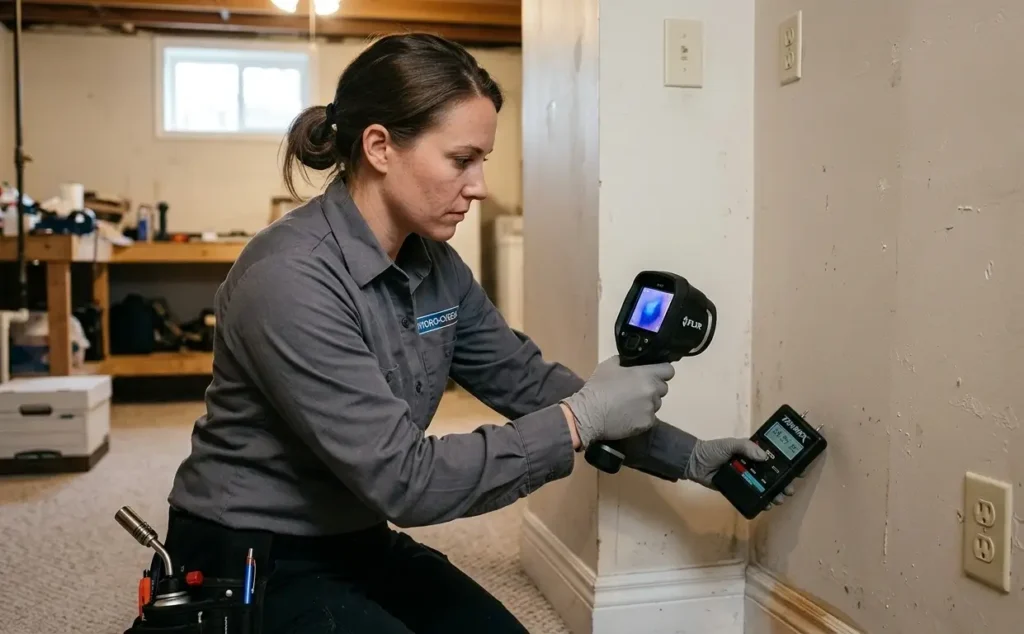
This is exactly where restoration professionals step in. Using specialized equipment, property experts can uncover these concealed issues before they spiral out of control. Today, we are pulling back the curtain on the industry’s best-kept secrets. We will explore how modern water-damage inspection tools enable professionals to detect the invisible, using moisture meters and thermal imaging cameras to identify hidden issues before they cause serious structural problems or fuel rapid mould growth.
Key Takeaways Before We Dive In:
- Looks Can Be Deceiving: A perfectly clean wall can hide gallons of trapped water.
- Time Is Not on Your Side: Hidden moisture degrades building materials rapidly and encourages mould spores to thrive in just 24 to 48 hours.
- Technology Saves the Day: Professional hidden water damage detection prevents unnecessary demolition by pinpointing the exact location of the moisture.
- Knowledge Is Power: Understanding how these tools work helps you make informed decisions about your property.
Why Hidden Water Damage Is a Serious Problem
We know how stressful property maintenance can be. It is easy to assume that if you cannot see a problem, it does not exist. Unfortunately, when it comes to property care, what you do not know can definitely hurt your wallet.
Moisture Trapped Inside Walls and Flooring
Water follows the path of least resistance. A slow drip from a faulty pipe can travel along the framework, soak into insulation, and pool beneath your hardwood floors without ever breaching the surface of your drywall. This unseen pooling is a nightmare for homeowners and landlords alike. Because the surface remains dry, the trapped moisture silently eats away at the structural integrity of your property. Routine visual checks simply cannot compete with true hidden leak detection.
Risk of Mould Growth
Mould is a word no property owner ever wants to hear. Hidden moisture creates the perfect breeding ground for mould. Fungi thrive in dark, damp, and warm environments, making the cavities behind your drywall an ideal nursery. If left unchecked, these spores can compromise your indoor air quality and represent major health risks to your family or tenants. Professional intervention is the cornerstone of effective mould growth prevention.
Structural Damage Over Time
Persistent moisture does not just sit there; it actively destroys. Over time, continuous exposure to water will warp wood framing, dissolve drywall, and ruin expensive insulation. This structural moisture weakens the actual bones of your building. A small, untreated leak today could mean replacing entire wall support systems tomorrow. Nipping the problem in the bud is necessary for maintaining the value and safety of your property.
What Is a Moisture Meter?
When you call a restoration expert, they do not just arrive with a flashlight and a hunch. They bring science to the table. Moisture meters are arguably the most crucial instruments in any restoration technician’s toolkit.
How Moisture Meters Work
Have you ever wondered how professionals detect water damage with such precision? A moisture meter is a handheld device calibrated to measure the exact percentage of water within a specific building material. Rather than guessing if a wall is damp, technicians use these devices to get hard data. When performing moisture meter water-damage assessments, the equipment measures electrical resistance or uses electromagnetic waves to quantify exactly how saturated a material is.
Types of Moisture Meters
Not all situations call for the same approach, which is why professionals carry different variations of this tool:
- Pin-type moisture meters: These devices feature two metal pins that physically penetrate the surface of the material. By measuring the electrical resistance between the pins, the meter determines the moisture content. Water conducts electricity, so lower resistance means higher moisture.
- Pinless moisture meters: When you want to avoid poking holes in a client’s beautiful hardwood floors, pinless meters are the go-to choice. They use sensor pads that emit electromagnetic frequencies to read moisture levels up to an inch below the surface without causing a scratch.
Where Moisture Meters Are Used
These versatile tools are utilized across almost every surface of a building. Technicians rely on them for rigorous drywall moisture detection, testing wood framing, scanning ceilings, and evaluating subflooring. Whether it is concrete or carpet, a quality meter provides the undeniable proof needed to take action.
Also Read: Signs of Hidden Water Damage in Older Homes & What to Do
How Thermal Imaging Detects Hidden Water Damage
If moisture meters provide the hard numbers, thermal imaging cameras provide the big picture. They give restoration professionals a superpower: the ability to see heat.
What Thermal Imaging Cameras Do
Thermal cameras do not see water itself. Instead, they detect subtle surface temperature differences on the surface of building materials using infrared thermography. Because wet materials hold and release heat differently than dry materials, a wet spot inside a wall will typically appear noticeably cooler on the camera’s display. When using thermal imaging for water damage detection, experts can scan entire rooms in a matter of minutes to detect anomalies.
Identifying Water Behind Walls and Ceilings
The ability to detect water behind walls without swinging a hammer is a game-changer. If a slow plumbing leak is trickling down the inside of a wall cavity, the thermal camera will display a distinct, cool, irregular shape outlining the exact path of the water. This precise approach takes the guesswork out of the equation.
Benefits of Infrared Inspections
Nobody wants a surprise indoor demolition project. One of the greatest advantages of this technology is its non-invasive nature. For an expert using a thermal camera, water leaks become glaringly obvious without tearing down drywall or pulling up floorboards prematurely. This saves property owners an incredible amount of time, money, and frustration.
Why Professionals Use Both Tools Together
You might be thinking, “If thermal cameras are so great, why do we even need moisture meters?” That is a brilliant question.
Thermal imaging is fantastic for quickly identifying suspected problem areas, but temperature drops can sometimes be caused by missing insulation or cold drafts rather than water. Therefore, an infrared camera tells the technician where to look, and the moisture meter confirms what they are looking at. That’s exactly the process our Waterdown restoration team follows on every inspection.
Key points on why this twofold approach is the gold standard:
- More accurate inspections: Verifying thermal anomalies with moisture readings eliminates false positives.
- Faster leak detection: Cameras scan large areas swiftly, guiding the technician straight to the source.
- Reduced property damage during inspection: By pinpointing the exact location of the water, technicians only remove the materials that are absolutely necessary.
Also Read: Post-Remediation Verification: Why PRV Testing Matters
Common Situations Where Hidden Water Damage Occurs
Water is incredibly crafty, and leaks can spring up in the most unexpected places. Our technicians frequently encounter the following scenarios across Toronto neighbourhoods:
- Plumbing leaks inside walls: Tiny pinhole leaks in older copper pipes require expert moisture detection in walls to uncover before they rot the framing.
- Roof leaks affecting ceilings: Water from a damaged roof often travels far from the original entry point, pooling silently above your ceiling.
- Appliance leaks: Dishwashers, washing machines, and refrigerators can all develop slow drips that ruin subflooring over time.
- Basement moisture problems: Poor drainage and foundational cracks can lead to invisible hydrostatic pressure and groundwater seepage.
- HVAC condensation leaks: Blocked AC drain lines can cause condensation to overflow directly into unseen ductwork or attic spaces.
Not all of these sources carry the same risk — how Category 1, 2 and 3 water affects the inspection process determines what protective equipment and cleanup methods technicians use.
The Professional Water Damage Inspection Process
When you book comprehensive water damage inspection services, you are investing in peace of mind. Here is exactly what happens when the experts arrive at your door.
Visual Inspection
Every great assessment starts with a trained eye. Technicians conduct a thorough building inspection, looking for subtle visual clues like peeling paint, bubbling wallpaper, warped baseboards, or faint musty odours that signal a larger issue.
Thermal Imaging Scan
Next, the lights might go off, and the infrared cameras come out. Technicians will sweep the suspected areas to identify temperature variations that indicate trapped moisture. This paints a vivid, colourful map of what is happening behind your walls.
Moisture Testing
Once the thermal scan highlights an area of concern, the technician moves in with the moisture meters. They will check the humidity levels and take precise moisture readings to confirm the presence and exact extent of the water intrusion.
Damage Assessment
Once all the data has been collected, restoration professionals analyse the situation, map the affected areas and develop a targeted professional water damage restoration plan that may include water extraction, dehumidification, structural drying, sanitisation and necessary repairs. Accurate detection here matters — how detection accuracy affects overall repair cost shows why missing hidden moisture early can significantly raise your final bill. This ensures the correct deployment of dehumidification equipment and targeted drying strategies to get your property back to normal quickly.
Also Read: Water Damage Restoration Checklist for Homeowners
Why Professional Moisture Detection Matters
Hidden water damage can worsen incredibly quickly if left untreated. What starts as a minor damp spot can evolve into a structural nightmare and a severe mould infestation in just a matter of days. Professional inspection tools help restoration experts identify moisture problems early, preventing costly repairs and drastically reducing the risk of a dangerous mould outbreak. Accurate detection allows technicians to target the exact areas affected, avoid unnecessary demolition, and begin a highly effective drying and restoration process immediately. Why guess when you can know for sure?
Unveiling the Invisible: A Quick Recap of Hidden Moisture Detection
Dealing with property issues is never fun, but keeping informed puts you back in the driver’s seat. As we have covered, water is a sneaky roommate that can hide behind your drywall, beneath your floors, and above your ceilings. Relying solely on your eyes is simply not enough.
By combining the wide-net scanning power of thermal imaging with the pinpoint accuracy of moisture meters, restoration experts can map out an invisible threat without tearing your house apart. This dynamic duo of technology ensures that structural damage is halted, mould is prevented, and your hard-earned property investments are protected. Catching a leak early is the absolute best way to save time, money, and stress down the road.
Schedule a water damage restoration in Hamilton inspection today.
If you suspect hidden leaks or moisture problems in your home, professional detection can help prevent costly structural damage. Contact Property Worx to schedule a comprehensive water-damage inspection and identify hidden moisture before it becomes a major issue.
