

Is this you? You walk into your living room after a heavy storm, only to find water dripping through the ceiling. Or maybe a hidden pipe bursts behind a wall, or a washing machine overflows, leaving the bottom of your drywall damp and discoloured. Panic sets in, and you immediately wonder what the next steps are. Do you just run a fan and hope for the best, or does the entire wall need to be torn out?
Homeowners often want a straightforward answer on whether they can simply dry wet drywall after water damage or if the material must be removed and replaced. The reality is that some drywall affected by limited, relatively clean water can be recovered quickly when addressed. However, severely saturated, structurally damaged, contaminated, or mould-affected drywall typically needs removal. Have you ever touched a water stain on drywall and thought it felt dry? It is tempting to consider the job done, but surface dryness does not always mean the wall cavity, framing, or insulation behind the gypsum board is actually dry.
Key Takeaways
Addressing water-damaged drywall properly is all about acting fast and knowing what lies beneath the surface. While some situations allow for structural drying, others pose safety risks that demand replacement. Here is a quick summary of what you need to know:
- Wet drywall can sometimes be saved if the damage is limited, the water source is clean, and the board remains structurally sound.
- Replacement is almost always necessary for drywall that is sagging, crumbling, severely swollen, contaminated, or showing signs of mould growth.
- Moisture meters and thermal imaging are essential tools for determining whether water remains trapped in wall cavities or ceilings.
- Professional moisture assessment takes the guesswork out of the process, ensuring hidden dampness does not lead to bigger problems down the road.
Can Wet Drywall Be Saved?
Yes, wet drywall can sometimes be saved. However, the true answer depends on several moving parts. Every water damage assessment is unique. The ability to salvage the material depends heavily on the amount of water absorbed, how long the drywall remained wet, and the source of the water. We also have to look at whether contaminants are present, the overall condition of the drywall paper and gypsum core, and whether the material is sagging or losing its structural strength.
It is also crucial to check whether the insulation behind the wall is wet, whether mould is present, and whether hidden moisture remains trapped in the wall cavity. It is tough to give a universal rule based solely on a specific number of hours. The material’s actual physical condition and measured moisture levels matter much more than its surface appearance.
Wet Drywall: Dry It or Replace It? Quick Comparison
To help you decide the best course of action, here is a breakdown of common scenarios and the recommended next steps.
| Condition | Drying May Be Possible | Replacement May Be Needed | Recommended Next Step |
| Minor clean-water exposure | Yes, if addressed quickly and the board remains intact. | No, usually not necessary. | Dry promptly and monitor moisture levels. |
| Small damp area | Yes, depending on hidden moisture. | Possibly, if water is trapped inside the wall. | Assess moisture behind the surface before deciding. |
| Soft or swollen drywall | No, structural integrity is likely compromised. | Yes, replacement is generally required. | Seek professional assessment to plan for removal. |
| Sagging ceiling drywall | No, the added weight of water makes this unsafe. | Yes, treat this as a serious safety hazard. | Avoid standing underneath and arrange for safe removal. |
| Crumbling drywall | No, the gypsum board is failing. | Yes, it cannot be salvaged. | Plan for demolition and drywall replacement. |
| Contaminated water exposure | No, health risks outweigh material salvage. | Yes, porous materials must go. | Professional extraction and safe disposal. |
| Visible mould | No, drying will not remove the spores. | Yes, contaminated boards need removal. | Requires proper mould assessment and remediation. |
What to Do Immediately When Drywall Gets Wet
When you discover wet drywall from a leak or flood damage, taking the right steps in the correct order helps minimize the fallout.
Stop the Water Source
Your very first priority is preventing any additional water from entering the area. If a fixture or appliance is leaking, shut it off immediately. You might need to close the appropriate water valve beneath a sink or behind a toilet. For a major plumbing failure, such as a burst pipe, shut off the main water supply to the house. If you are dealing with a roof leak, you will need to have it professionally repaired as soon as it is safe to do so. Please remember to put your safety first, and never enter an unsafe, heavily flooded area to reach a valve.
Check for Electrical and Structural Hazards
Water and electricity are a dangerous combination. Any water near electrical outlets, wiring, fixtures, or electrical panels requires extreme caution. Never touch wet electrical equipment, and avoid standing beneath noticeably sagging wet ceilings, as they can collapse under the weight of the water.
Remove Standing Water
Once the area is safe, surface water should be removed promptly so that your drywall, baseboards, flooring, and subfloor do not continue absorbing moisture. Use mops or a wet vacuum for minor spills. For significant water intrusion, professional water extraction may be necessary to quickly remove the bulk of the moisture.
How to Dry Wet Drywall After Water Damage
The structural drying process involves more than just pointing a fan at a wet wall. Here is a step-by-step guide to tackling the job, keeping in mind that larger incidents require professional equipment.
Step 1: Identify the Full Wet Area
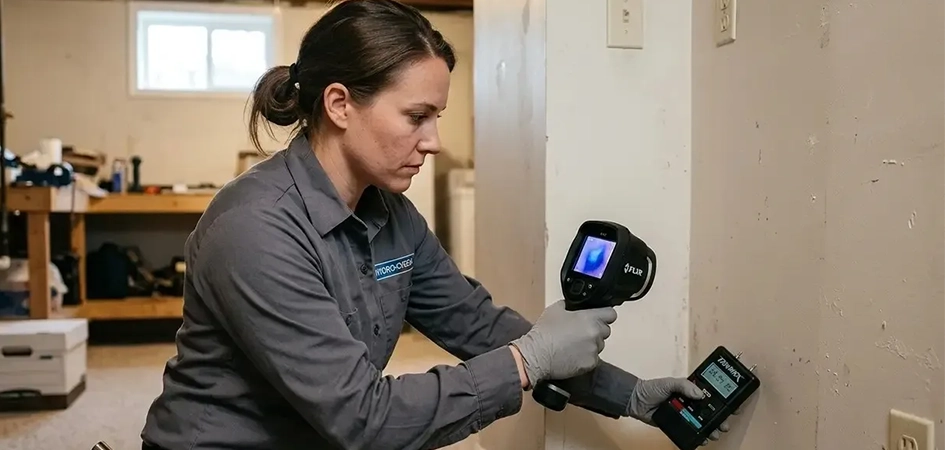
The visible water stain is often just the tip of the iceberg. Water is tricky, and it can travel behind drywall, along studs, beneath baseboards, into insulation, through ceiling cavities, and into your flooring. Professional moisture meters and thermal imaging can help identify hidden moisture that you simply cannot reliably detect by touch alone. Property Worx uses these advanced tools specifically to map and identify water trapped in walls, ceilings, and floors.
Step 2: Remove Wet Materials That Cannot Be Saved
If the damage is severe, some materials will only hinder the drying process. Saturated insulation, damaged baseboards, and severely deteriorated drywall may need to be removed so that trapped moisture does not remain within the wall assembly and cause further rot. That being said, homeowners should avoid performing invasive demolition when contamination, electrical hazards, structural damage, or significant mould growth is suspected.
Step 3: Increase Airflow
Controlled airflow helps move moisture away from wet surfaces, speeding up evaporation. While setting up a few fans is a good start for a minor spill, professional air movers are designed to direct high-velocity air exactly where it is needed. Keep in mind that simply opening windows is not always sufficient, as outdoor humidity and weather conditions can actually slow the drying process down.
Step 4: Use Dehumidification
Pulling moisture out of the materials is only half the battle, as that moisture then enters the air. Dehumidifiers remove moisture from the indoor environment, lowering the relative humidity and supporting the overall drying process. Professional structural drying rarely relies on a single method. Instead, it combines controlled airflow with powerful dehumidification. Property Worx uses advanced structural drying and dehumidification as a core part of its water damage restoration services.
Step 5: Monitor Moisture Levels
Drywall should never be assumed dry just because the surface colour improves or it feels dry to the touch. Monitoring moisture levels with professional equipment and comparing them with those of unaffected materials is a vital step. Confirming dryness helps ensure walls are not closed, repaired, or painted while moisture remains trapped inside.
How Long Does Wet Drywall Take to Dry?
There is no universal drying time for water-damaged drywall. The timeline depends heavily on the severity of the saturation, the size of the affected area, the water source, and the ambient temperature and indoor humidity. It also depends on the wall construction, the presence of insulation, whether both sides of the drywall can release moisture, and how quickly the drying process started. We avoid promising a fixed drying period. The safest approach is always to verify moisture reduction rather than just wait a predetermined number of days.
Signs Wet Drywall May Need to Be Replaced
Sometimes drying just is not an option. Here are the strongest indicators that you need wet drywall replacement:
- The drywall feels very soft or mushy to the touch.
- The gypsum board is crumbling or falling apart.
- The drywall has lost its shape, showing severe swelling or bowing.
- You notice sagging, especially on a wet ceiling.
- The drywall paper facing is separating or experiencing delamination.
- Large areas are fully saturated and have been for days.
- Contaminated water, such as a sewage backup, contacted the drywall.
- Mould is visible or strongly suspected based on odours.
- Wet insulation behind the wall cannot be adequately addressed.
- The drywall remains damp despite a controlled drying setup.
- Structural materials behind the wall require access for repair.
Professional assessment is particularly important when damage extends beyond the visible surface.
What About Wet Ceiling Drywall?
Wet ceiling drywall presents a unique set of safety concerns because gravity is working against you. Warning signs of a failing ceiling include bulging, sagging, bubbling paint, spreading ceiling stains, dripping water, and new cracks forming around the affected area. If you notice these signs, do not stand beneath a visibly sagging or unstable wet ceiling. Water is likely collecting above the drywall, and the source needs to be professionally assessed before any cosmetic repairs begin.
What If There Is Wet Insulation Behind the Drywall?
Insulation does a great job of regulating temperature, but it is also exceptionally good at holding onto water. Wet insulation can trap moisture inside a wall or ceiling cavity, making the drywall surface feel dry even when it is soaking wet behind the scenes. This trapped moisture significantly slows down the drying process and usually requires professional access and evaluation. The entire wall assembly needs to be assessed as a connected system, rather than focusing exclusively on the drywall surface.
Does Wet Drywall Always Develop Mould?
Mould is not guaranteed to form every time drywall gets wet, but persistent moisture creates the perfect storm for spores to thrive. The drywall’s paper facing acts as an organic food source. When combined with hidden moisture inside wall cavities, high humidity, or repeated leaks, the risk of microbial growth skyrockets. Musty odours, visible spotting, or dark discolouration are strong indicators of a problem. Property Worx advises acting quickly to handle water removal, drying, and humidity control. We also recommend taking a look at our guide on how to prevent mould after water damage restoration to keep your home safe. If you suspect an issue is already present, our expert mould removal and remediation team can properly assess and resolve the situation.
Does the Type of Water Affect Whether Drywall Can Be Saved?
Yes, the source and contamination level of the water will heavily dictate your restoration decisions. Cleaner water sources, such as a fresh supply-line leak, are generally easier to manage if you address them promptly. More contaminated water, perhaps from an appliance discharge such as a dishwasher, poses a higher risk and requires careful handling. Highly contaminated water, such as a sewage backup or outdoor flood damage, is a completely different story. In these scenarios, porous materials require immediate removal under strict professional restoration protocols. We strongly advise against DIY handling of sewage or heavily contaminated materials. When the water source is uncertain, bringing in a professional assessment is always the safer approach.
Common Mistakes When Trying to Dry Wet Drywall
Even well-meaning homeowners can accidentally make the situation worse. Here are a few pitfalls to avoid:
- Painting over a water stain too early: Slapping on a coat of paint might hide the stain, but a cosmetic covering does not remove hidden moisture.
- Assuming the wall is dry because it feels dry: Surface evaporation occurs quickly, but moisture often remains trapped beneath the surface and in the studs.
- Ignoring wet insulation: Leaving saturated insulation untouched means trapped moisture will remain inside the wall cavity, eventually rotting the framing.
- Using only household fans after significant water damage: A ceiling fan is fine for a spilled glass of water, but larger losses require controlled air movement, industrial dehumidifiers, extraction, and diligent moisture monitoring.
- Repairing the drywall before fixing the water source: The problem will inevitably return if the actual leak or intrusion is not corrected first. This is especially true if you are having trouble figuring out how to tell if water damage is old or new.
- Ignoring musty odours: Persistent odours are your home’s way of telling you that hidden moisture or microbial activity is happening out of sight. It deserves immediate investigation.
When to Call a Professional Water Damage Restoration Company
While a tiny splash can be wiped up with a towel, many situations require expert intervention. Professional assessment is recommended when a large drywall area is wet, water has entered walls or ceilings, or water is cascading through multiple levels of the home. You should also reach out if the source is contaminated or uncertain, if ceiling drywall is sagging, or if insulation is saturated.
Do not hesitate to get help if mould is visible or suspected, if the leak was hidden for an unknown period, or if flooring and structural materials are affected. If moisture remains after DIY drying attempts, or if you need proper professional documentation for an insurance claim, it is time to call a professional water damage restoration company. Property Worx handles the heavy lifting, ensuring your property is safe, dry, and restored to its original condition.
How Property Worx Handles Wet Drywall and Water Damage
When our team arrives on site, the process begins by identifying the exact source of the leak and determining exactly how far the moisture has travelled. We conduct a thorough water damage inspection utilizing advanced moisture detection, thermal imaging, and moisture mapping. This lets us see what the naked eye cannot. We then initiate water extraction and controlled structural drying using commercial-grade air movers and dehumidification equipment.
We assess the condition of both your drywall and insulation and perform targeted removal of materials that cannot be safely restored. From there, we focus on detailed cleaning, sanitization, and a comprehensive mould-risk assessment. We also handle the resulting drywall and structural repairs, provide thorough documentation for your insurance claims, and manage the reconstruction where required. Property Worx ensures that the underlying moisture in your walls and ceilings is located and addressed so you can have total peace of mind.
How to Prevent Drywall Water Damage in the Future
The best way to deal with wet drywall is to stop it from happening in the first place. Make a habit of promptly repairing plumbing leaks and regularly inspecting appliance supply lines, particularly those behind washing machines and refrigerators. Monitor the areas beneath your sinks for small drips, and maintain your roofing and flashing to keep the weather outside where it belongs.
Ensure your gutters and drainage systems are clear to direct water away from your foundation. Inspect your basements for early signs of moisture, and keep your sump pumps maintained if you have them. Watch out for condensation problems on windows and walls, and consider using smart leak-detection sensors in vulnerable areas. Keep a close eye on ceilings located directly below bathrooms or plumbing fixtures, and always investigate water stains immediately. Remember, do not repeatedly paint over unexplained stains. Early investigation saves you from dealing with visible damage down the road.
Why Choose Property Worx?
When disaster strikes, you need a partner you can trust to protect your investment. Property Worx offers a 24/7 emergency water damage response because we know that leaks do not wait for regular business hours. We provide expert professional water extraction, relying on precision moisture detection and thermal imaging to find every drop of hidden water.
Our team excels in structural drying and dehumidification for both residential and commercial restoration projects. We also offer robust mould remediation support, safe removal of water-damaged materials, and seamless repairs. Navigating an insurance claim is stressful, which is why we assist with comprehensive restoration documentation to make the process smoother for you. Serving Toronto and the GTA, Property Worx delivers full restoration and reconstruction capabilities to get your property back to normal safely and efficiently.
Wet Drywall? Dry It Properly Before the Damage Spreads
Dealing with water damage is stressful, but understanding your options puts you back in control. Wet drywall can sometimes be successfully dried and restored, but the right decision hinges entirely on the water source, the level of saturation, the structural condition of the board, and whether hidden moisture or mould is involved. Homeowners should never rely solely on a wall’s surface appearance to determine if it is genuinely dry.
If you are facing water intrusion and are unsure of the extent of the damage, do not leave it to chance. Trust the experts to evaluate the situation accurately. Reach out to Property Worx today for professional moisture detection, structural drying, and expert drywall assessment. Let us help you protect your home before the damage spreads any further.
