

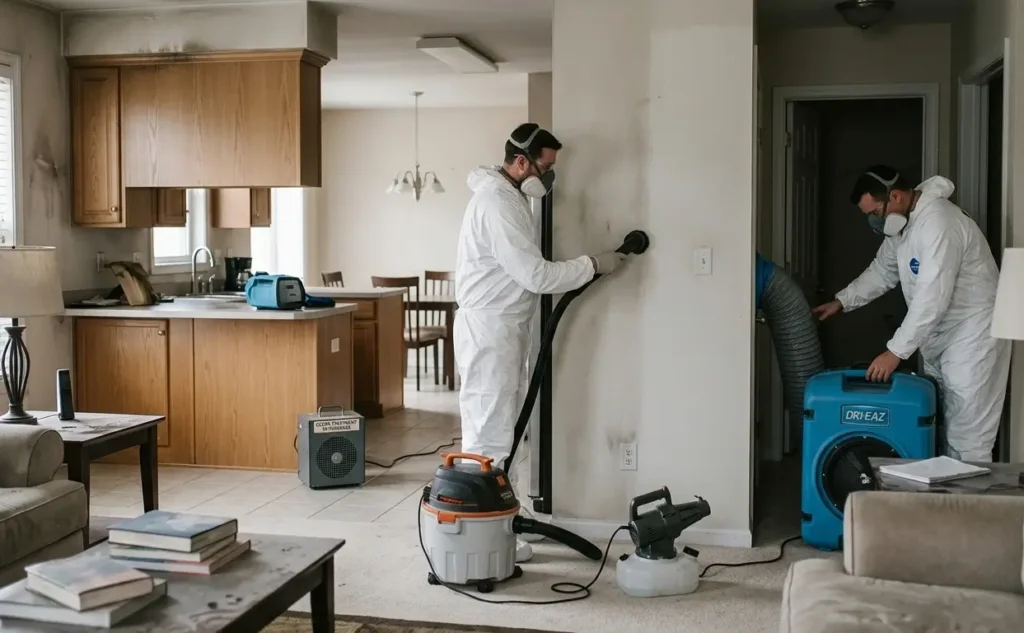
The fire trucks have packed up, the sirens have faded into the distance, and you are finally allowed to step back inside your Toronto home. It is a moment filled with profound relief, but also overwhelming stress. The flames might be completely extinguished, but another invisible, highly invasive element has taken up residence in your living space. We are talking about that unmistakable, acrid campfire smell. If you are dealing with a smoke smell in a house after a fire, you already know it is one of the most stubborn, persistent problems a property owner can face.
Even a minor kitchen mishap or a minor electrical short can leave a pungent scent lingering for weeks. Why is this the case? Because microscopic smoke particles are absolute masters of disguise. They slip into your walls, bury themselves deep in your favourite armchair, and hitch a ride through your ventilation system to contaminate every single room in the building. You might be tempted to break out the bleach, grab your scrub brushes, and tackle the problem head-on. However, DIY solutions often just scratch the surface of the issue. Completely eradicating that smell usually requires highly specialized knowledge and equipment. Acting quickly is equally important because untreated smoke and soot can continue damaging surfaces and belongings. Learning how a fast response reduces total fire damage cost can help homeowners avoid more extensive cleanup, replacement and reconstruction.
Today, we are going to walk you through exactly how to tackle this frustrating problem. We will cover the limits of household cleaning methods, the science behind odour removal, and when it is time to bring in experts for certified fire and smoke damage restoration.
Key Takeaways
- Smoke is incredibly invasive: It travels far beyond the original source of the fire, settling deep into porous surfaces, structural framing, and hidden ductwork.
- DIY methods have strict limits: Common household cleaners and natural remedies are only truly effective for minor, surface-level odours.
- Professionals rely on advanced science: Experts utilize highly specialized equipment to neutralize toxic odours completely at the molecular level, rather than just masking them.
- Safety always comes first: You have to prioritize structural integrity, indoor air quality, and proper documentation for your insurance provider before starting any physical cleanup.
Why Smoke Odour Lingers After a House Fire
How Smoke Particles Spread Throughout a Home
Have you ever noticed how the smell of burnt toast in the kitchen somehow manages to reach the second-floor bedrooms in a matter of seconds? Smoke behaves exactly like a gas, expanding rapidly and moving constantly toward cooler areas and the upper levels of your home due to a phenomenon known as the stack effect. During a fire, the immense heat pressurizes the smoke, driving it forcefully into the tiniest cracks, crevices, and gaps in your home’s construction. These tiny particles travel swiftly through open hallways, sneak under tightly closed doors, and get sucked into your ventilation system. By the time the fire is officially out, the smoke has effectively mapped out every square inch of your property.
Why Smoke Gets Trapped in Walls, Furniture, and Fabrics
Imagine your home is a giant, dry sponge. Wood, drywall and insulation, plush carpets, and soft upholstery are all highly porous materials. When they are exposed to smoke, they do not just get dirty on the outside. They actually absorb the greasy soot residue deep into their inner fibres and microscopic pores. As the temperature inside the house eventually cools down, the pores of these building materials naturally close up, effectively trapping the smoke particles inside like a time capsule. This is exactly why you can scrub a painted wall until your arm aches, only to find the room still smells terribly like a barbecue pit a few hours later.
Health Risks of Lingering Smoke Residue
Living with that burnt smell is not just an annoying nuisance. It is an active, ongoing threat to your physical well-being. Lingering soot and smoke drastically reduce your indoor air quality. These microscopic remnants contain a cocktail of toxic chemicals, including carbon monoxide, formaldehyde, and tar. Breathing them in day after day can trigger severe asthma attacks, cause chronic migraines, and lead to long-term respiratory issues. If you have young children, elderly family members, or pets living in the house, their developing or weakened lungs are even more vulnerable to these toxic hitchhikers.
Immediate Steps to Take After a House Fire
Ensure Safety and Structural Inspection
Before you even begin to research how to remove smoke smell from your house after a fire, you need to hit the pause button and heavily focus on your safety. Fire severely weakens structural supports, melts hidden electrical wiring, and compromises the integrity of your roof and floorboards. Always get explicit, official clearance from the local fire department or a licensed structural engineer before setting foot inside the property. No piece of antique furniture is worth risking a sudden ceiling collapse.
Ventilate the Home Properly
Once you have the official green light to re-enter your home safely, your very first line of defence is fresh air. Throw open every window and door you can safely access to the outside. Set up large industrial box fans, pointing outward, to blow the contaminated, smoky air directly out of the house. Creating a strong, continuous cross-breeze helps flush out the loose, airborne particles before they have a chance to settle deeper into your belongings.
Document Damage for Insurance Claims
We know you want to start cleaning immediately to regain a sense of normalcy, but you must wait. Pull out your smartphone and take a massive amount of high-resolution photos and videos. Document every single charred wall, every soot-stained carpet, and every water-logged piece of furniture. Your insurance adjuster will absolutely need this detailed evidence to process your insurance fire damage claims smoothly. A thorough visual record ensures you get the proper financial compensation you need for professional restoration services down the road.
DIY Smoke Odour Removal Methods (What Homeowners Can Try)
Ventilation and Air Purification
For very minor incidents, such as a localized kitchen fire that was extinguished quickly, you might be able to manage the resulting odour yourself. Keep those windows wide open and invest in a high-quality, standalone air purifier equipped with both a True HEPA filter and a thick activated carbon layer. The HEPA filter actively captures floating soot particles, while the carbon layer physically absorbs the noxious odours. Let the purifier run continuously on its highest setting in the affected rooms.
Cleaning Hard Surfaces
Grab a bucket, put on some heavy-duty gloves, and get ready to use some serious elbow grease. For solid, completely non-porous surfaces like window glass, ceramic tile, and metal countertops, a mixture of hot water and a heavy-duty alkaline degreaser can work wonders. Wash down the walls and floors meticulously from the top down to prevent streaking. Remember to change your cleaning water frequently. Otherwise, you are just painting the dark soot residue right back onto your clean walls.
Washing Fabrics and Upholstery
Your soft goods are going to require a lot of tender loving care. Remove all washable curtains, throw blankets, and clothing from the house immediately. Wash them in warm water, adding a full cup of white vinegar to the cycle to help break down embedded odours. For larger items that cannot be thrown in the washing machine, like area rugs or your favourite velvet sofa, you might need to sprinkle them generously with dry baking soda, let the powder sit undisturbed overnight, and vacuum it up thoroughly the next day.
Also Read: How Long Does Fire Damage Restoration Take?
Using Odour Absorbers
Mother Nature provides us with some pretty decent, entirely natural odour neutralizers. Placing shallow bowls of white vinegar, chunks of activated charcoal, or even dry coffee grounds around the perimeter of the room can help absorb mild lingering smells over time. This DIY smoke odour removal tactic is cheap, incredibly easy to set up, and completely safe for your family. However, you must keep your expectations realistic. These natural absorbers are fantastic for clearing the smell of a burnt casserole, but they are a mere drop in the bucket compared to the aftermath of a full-blown living room fire.
The Limits of DIY Smoke Odour Removal
Smoke Hidden in HVAC Systems
Here is exactly where DIY cleaning efforts usually hit a massive brick wall. When your furnace or air conditioner kicks on during or immediately after a fire, it aggressively pulls smoky air into the return vents and pushes it through your entire ductwork system. The greasy soot coats the inside of your hidden ducts, creating a massive area of HVAC contamination. Every single time you turn on the climate control, you are essentially blowing a fresh wave of toxic smoke right back into your clean living space. You simply cannot reach deep enough into your metallic ducts with a damp sponge and a prayer.
Smoke Embedded in Structural Materials
Do you recall our earlier sponge metaphor? Once smoke particles successfully penetrate the highly porous layers of your home, basic surface cleaning becomes practically useless. The smoke gets trapped deep behind the baseboards, seeps heavily into the attic insulation, and clings tightly to the raw wood framing of your house. It is a lot like trying to unbake a cake. You absolutely cannot just wash the flour out once it has been baked into the final product.
When DIY Cleaning Stops Working
If you have scrubbed, washed, aired out, and diligently deodorized your home for a full week, and the living room still smells like a busy barbecue pit, your DIY journey is officially over. Trying to mask the scent with expensive perfumed candles or heavy aerosol air fresheners will only give you a massive headache. At this specific point, the odour is structural, and tackling it requires industrial-grade science and professional intervention.
Professional Smoke Odour Removal Techniques
HEPA Air Scrubbers and Filtration
When the restoration pros roll into your driveway, they bring the heavy artillery. Professional smoke odour removal starts with the deployment of commercial-grade HEPA air scrubbers. These massive machines are light-years ahead of your standard bedroom air purifier. They cycle the entire volume of air in a room multiple times an hour, aggressively pulling out microscopic soot, loose ash, and dangerous volatile organic compounds. This rapid, continuous filtration drastically improves the indoor air quality almost immediately — it’s the same standard we bring to every fire and smoke damage restoration in Milton job.
Thermal Fogging
If you are looking for the absolute gold standard in the restoration industry, thermal fogging smoke odour removal is it. Restoration experts use specialized thermal equipment to heat a specific deodorizing chemical, instantly turning it into a dense, fine mist. Because this artificial fog is heated to a high temperature, it behaves exactly like the original fire’s smoke. It naturally expands, pressurizes the room, and penetrates the exact same microscopic pores in your drywall and furniture that the smoke originally did. Once safely inside those pores, the fog fully neutralizes the odour at the molecular level.
Ozone Treatment
Sometimes you need to wage literal chemical warfare against stubborn smells. Using an industrial ozone generator, professionals safely flood the completely sealed environment with concentrated ozone gas. The extra, highly reactive oxygen atom in the ozone attaches itself directly to the smoke molecules, completely oxidizing and permanently destroying them. Ozone treatment after fire is incredibly effective, but it is also hazardous to breathe during the active process. Therefore, the home must be completely evacuated of all people, pets, and even living houseplants until the treatment is complete and the space is fully ventilated.
Hydroxyl Generators
If evacuating the property for several days is simply not feasible, property restoration specialists might opt for a hydroxyl generator instead. This incredible technology perfectly mimics the way the sun naturally cleans the Earth’s atmosphere. It uses specific wavelengths of ultraviolet light to generate safe hydroxyl radicals that break down odour molecules on contact. While it generally takes a little longer to work than aggressive ozone, it is completely safe to run while people are occupying the building.
Also Read: Renovating vs Rebuilding After Fire Damage
The Professional Fire Restoration Process
Damage Assessment
Before any scrub brushes are lifted or machines are plugged in, professional crews conduct a meticulous, top-to-bottom inspection. They use specialized moisture meters to detect trapped water from firefighting efforts and trace the exact path the smoke took through your home’s layout. This comprehensive blueprint ensures no hidden pocket of soot is accidentally left behind — it’s the same process our Halton Hills fire restoration team follows on every job.
Soot and Residue Removal
Not all soot is created equal. A grease fire in the kitchen leaves a highly sticky, smeary residue, while a fast-burning paper fire leaves a dry, powdery ash. The restoration team will use highly specific dry-chemical sponges, heavy alkaline cleaners, and targeted structural cleaning techniques tailored to the type of chemical residue coating your property.
Deodourization Treatments
This phase is where the real magic happens. After the physical, visible soot is gone, the crew deploys the heavy deodorization machinery we mentioned earlier. Whether the situation calls for thermal fogging, ozone, or hydroxyls, this critical step ensures the complete eradication of the lingering scent, rather than just temporarily masking it with a flowery, artificial fragrance.
Final Restoration and Sealing
Sometimes, raw wood framing or subflooring is permanently stained by dark smoke but remains structurally sound and safe. In these specific cases, professionals use specialized, heavy-duty odour-blocking sealers and primers. This effectively encapsulates the wood, trapping any residual, microscopic smells inside forever, so you never have to worry about them creeping out on a highly humid summer day. Once the smoke and soot cleanup is complete, damaged areas may still need to be repaired or rebuilt. Understanding whether you need a restoration company or a general contractor for fire rebuilds can help you choose the right professionals for the remaining work.
Also Read: Is It Safe to Stay Home After a House Fire?
Materials That Often Need Replacement After Fire Damage
- Insulation
- Carpets and Padding
- Drywall
- Cabinets and Upholstery
Let us be brutally honest for a moment. Some battles simply cannot be won. Fibreglass and cellulose insulation are basically giant smoke traps and almost always need to be thrown away entirely. Wall-to-wall carpets and their underlying foam padding act like giant, absorbent filters for falling ash and dirty firefighting water, making full replacement the safest and most hygienic option. Severely charred or water-logged drywall will rapidly lose its structural integrity, lose its fire rating, and crumble over time. Finally, heavily damaged particleboard cabinets and deeply permeated upholstered couches often cost significantly more to restore properly than to replace outright.
How Long Does Smoke Odour Removal Take?
One of the most frequent questions we hear from stressed homeowners is, “How long does smoke smell last after a fire?” The honest, straightforward answer is that it depends entirely on the severity of the incident and the specific methods used to clean it up. If you had a minor kitchen flare-up and you act very quickly, professional cleaning and deodorization might only take 1 to 2 days. A moderate fire that spread heavy smoke through the main hallways could require several days of intensive air scrubbing and thermal fogging. However, if your home suffered severe structural fire damage requiring extensive demolition, major structural repairs, and comprehensive deodorization, you could easily be looking at several weeks of active, ongoing restoration. Smoke deodorization is only one stage of recovery. Homeowners should also understand how long the full fire restoration process usually takes when demolition, insurance approvals, structural repairs and reconstruction are required.
Preventing Smoke Odour From Returning
You have painstakingly gone through the entire cleanup process, and your home finally smells like home again. How do you ensure it stays that way? First, schedule a professional, deep cleaning of your HVAC system to ensure absolutely no hidden soot is blown back into your clean living room. Second, ensure that any compromised, porous surfaces that were saved and not replaced are properly treated with a specialized smoke-sealing primer before you apply any fresh paint. Lastly, running high-quality HEPA air purification systems continuously for a few weeks after the restoration is complete will help capture any stray microscopic particles that may have settled during the reconstruction phase.
Also Read: Fire Damage Restoration: Costs, Insurance, and Process
When to Call Professional Fire Restoration Experts
If you are still sitting on the fence, wondering if you truly need professional help, look closely for the obvious warning signs. If a persistent smoke smell remains noticeably strong after a full week of aggressive DIY cleaning, it is time to call for backup. If you find dark, visible soot inside your HVAC vents, or if the fire damage restoration services required clearly go beyond a simple surface wipe-down, do not try to tackle it alone. Most importantly, if anyone in your household is actively experiencing coughing, persistent wheezing, or unexplained allergic reactions, you need expert intervention immediately to protect your family’s health.
Why Property Worx Is the Trusted Choice for Smoke Damage Restoration
Dealing with the chaotic aftermath of a house fire is exhausting, deeply emotional, and overwhelming. You do not have to navigate this complicated, stressful process alone. Located right here in Toronto, Property Worx is your premier, trusted partner for complete fire damage recovery. Our dedicated team of certified restoration specialists uses state-of-the-art equipment to tackle everything from the initial debris removal to advanced thermal fogging and complete structural repairs. We pride ourselves on delivering a fast emergency response because we know that every single hour counts in halting secondary damage to your property. We handle the dirty work, the heavy lifting, and the complex science of deodorization, so you can focus entirely on getting your family’s daily life back to normal.
Breathing Easy Again: Securing a Fresh Start After Fire Damage
Recovering from a fire is a long journey, and eliminating that stubborn, toxic smoke odour is a massive milestone along the way. We have covered a lot of important ground today. We explored why smoke particles are so invasive, discussed the helpful but distinctly limited scope of household cleaning tricks, and highlighted the undeniable, molecular power of professional treatments like ozone and thermal fogging. Remember, you do not have to live your life haunted by the pungent ghost of a fire in your hallways.
Schedule professional fire and smoke restoration in Burlington today and let the experienced experts at Property Worx return your home to a safe, fresh, and welcoming sanctuary.
Would you like to know exactly what it will take to thoroughly restore your property? Get a Free Fire Damage Assessment from our local Toronto team right now.
